

ストーリー
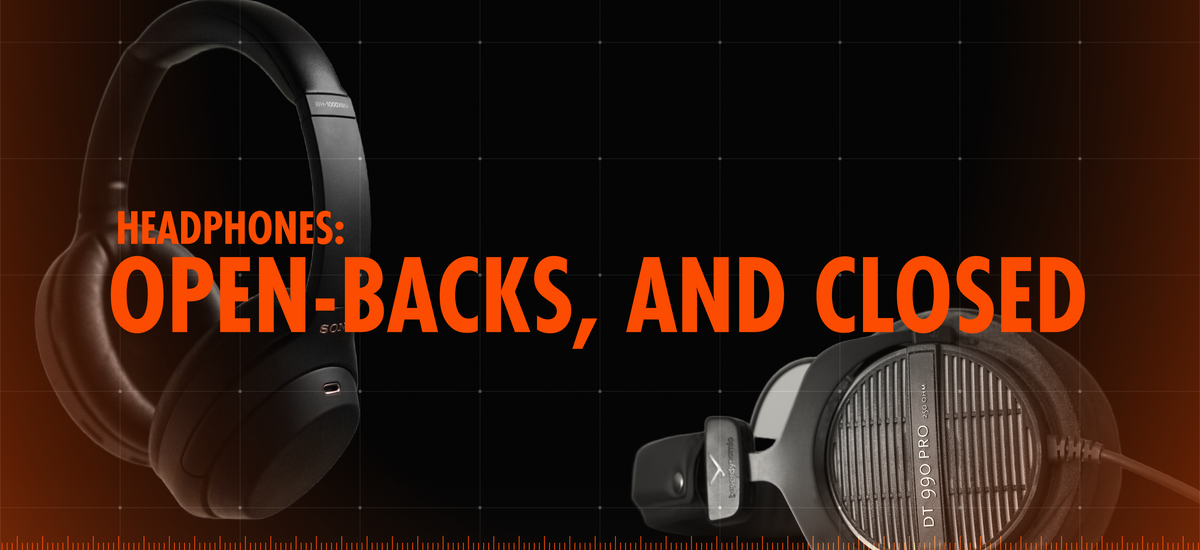
Headphones: Open-Backs, And Closed
Open-back headphones get praised for wide soundstages. Closed-backs get praised for isolation. But neither tells the whole story. A breakdown of how open-back, closed-back, and in-ear designs each shape sound, and why imaging — the ability to place a sound precisely in space — matters more than making it feel big.

SAN Sound is Breaking Into Three of Asia’s Biggest Markets
SANWEAR is coming to Rakuten, e☆Earphone, Amazon Japan, Coupang, Naver, Shopee, and Lazada this October.
もっと読むSAN Sound is Breaking Into Three of Asia’s Biggest Marketsについて
Four years ago, SAN was boxes stacked in a hallway. Devin and DL reflect on how a community project became a global audio brand, the moments they almost didn't make it, and what comes next.

Meet BattleFlex, a new cable option for HARDWIRE. 14cm longer, more flexible, and built with reduced cable microphonics for gaming, exercise, and everyday life. Same HARDWIRE, a different way to wear it.

There is Nothing Quite Like Beryllium
Beryllium drivers are prized in high-performance earbuds for their exceptional stiffness, low weight, fast response, and resistance to distortion. In this article, SAN Sound explains why beryllium is used in SANWEAR gaming earbuds, how it compares with common diaphragm materials like PET, PEEK, and LCP, and how driver materials, acoustic tuning, and signal processing work together to produce accurate bass, detailed mids, clear highs, and precise spatial audio.

Audio Addiction: Why Some Headphones Are Forgettable and SANWEAR Isn't
もっと読むAudio Addiction: Why Some Headphones Are Forgettable and SANWEAR Isn'tについて

HARDWIRE-OS Update: Mute Your Mic Without Reaching for Your Phone
もっと読むHARDWIRE-OS Update: Mute Your Mic Without Reaching for Your Phoneについて

To us, the simplicity of a single-driver system is what makes it so powerful.

The In-Ear Advantage: What In-Ear Headphones Do That Over-Ear Doesn’t
In-Ear vs. Over-Ear: Over-ear headphones work with the outer ear to create a massive, open soundstage more naturally; while in-ear headphones bypass the ear-cup chamber entirely to deliver superior spatial audio through better sound isolation, faster sound travel, and better pinpoint positional accuracy.
Soundstage vs. Imaging: Soundstage defines the perceived scale of the listening space, while imaging determines the precise localization of individual sounds within that space.
Better Sound Isolation: In-ear monitors bypass the physical ear cup reflections and acoustic dampening inherent to over-ear designs. This creates a more consistent and stable sound transfer environment, able to create better and more replicable directionally accurate sound cues with pinpoint imaging.
Hardware Perfectly Replicating The Signal: HARDWIRE uses our new Planar-Dynamic drivers, alongside the Audio Cortex’s built-in DAC, amplifier, and DSP, to deliver the scale and experience of an open-back headphone's soundstage, but with an in-ear headphone's imaging precision and level of detail. The result is sound that we can only describe as Holographic.
もっと読むThe In-Ear Advantage: What In-Ear Headphones Do That Over-Ear Doesn’tについて

Holographic Audio: Beyond 3D Spatial Sound
The Three Markers of Great Spatial Audio: Accurately reproducing 3D sound requires hardware to cleanly deliver directional placement (360-degree positioning), distance perception (including acoustic reflections and volume variance), and elevation (distinguishing sounds above or below the listener). These three things are what seprates good spatial audio from the great.
Sub-Bass Directionality: Standard systems lose positional accuracy below 80Hz. SANWEAR preserves directional cues and micro-textures down to the sub-bass range, maintaining excellent accuracy across a wider range of the sound spectrum.
Single-Driver Excellence: Multi-driver systems split frequencies across different drivers, introducing unavoidable phase distortion and timing errors. SANWEAR is designed around a single dynamic driver design to preserve complete coherency and zero phase distortion across the full-spectrum.
Driver Displacement and Micro-Details: HARDWIRE's next gen Planar-Dynamic Drivers introduce enhanced diaphragm travel and air displacement, which allows the driver to push more air rapidly without distortion. Perfect for replicating subtle high-frequency cues needed to project even greater spatial accuracy such as the verticality of sound cues.
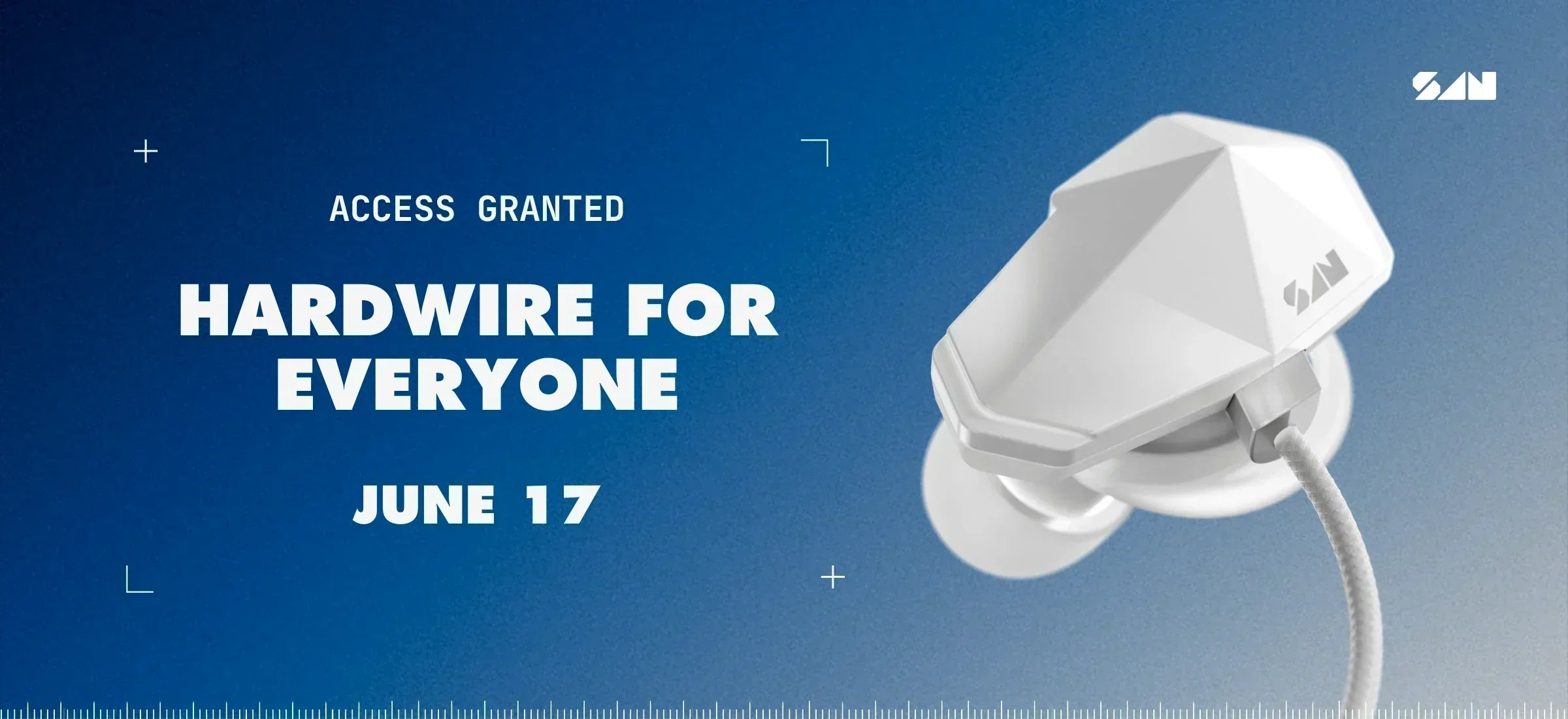
UPDATE: HARDWIRE FOR EVERYONE | Open Availability Starts June 17
Over the next month, we’ll be transitioning to full availability for SANWEAR-HARDWIRE starting June 17th at Midnight EST
もっと読むUPDATE: HARDWIRE FOR EVERYONE | Open Availability Starts June 17について

“Can Software Fix My Wired Earbuds?” | Digital Signal Processing
The Good, And The Bad, of DSP: Digital Signal Processing (DSP) manages frequency balance, timing alignment, and spatial audio. While software can smooth out harshness and standardize factory output, it cannot fix weak, slow, or physically defective, or subpar, drivers.
With Great Processing Comes Great Responsibilities: Heavy DSP filtering alters the original source signal. When done excessively, this creates audio artifacts, subtle latency, and potential distortion especially if users mismanage complex EQ sliders.
Refinement Over Correction: Our philosophy at SAN Sound prioritizes physical hardware quality over software processing. The drivers need to be up to our standards first first, before using DSP which we strictly use to refine sound and preseve the signal purity, rather than mask hardware flaws.
The Audio Cortex: Inside HARDWIRE, the integrated DSP as part of the Audio Cortex ensures spatial layer separation, pin-point positional game cues, and vocal clarity are always sharp and on point, without relying on additional software post-processing that is destructive to the audio quality.
もっと読む“Can Software Fix My Wired Earbuds?” | Digital Signal Processingについて
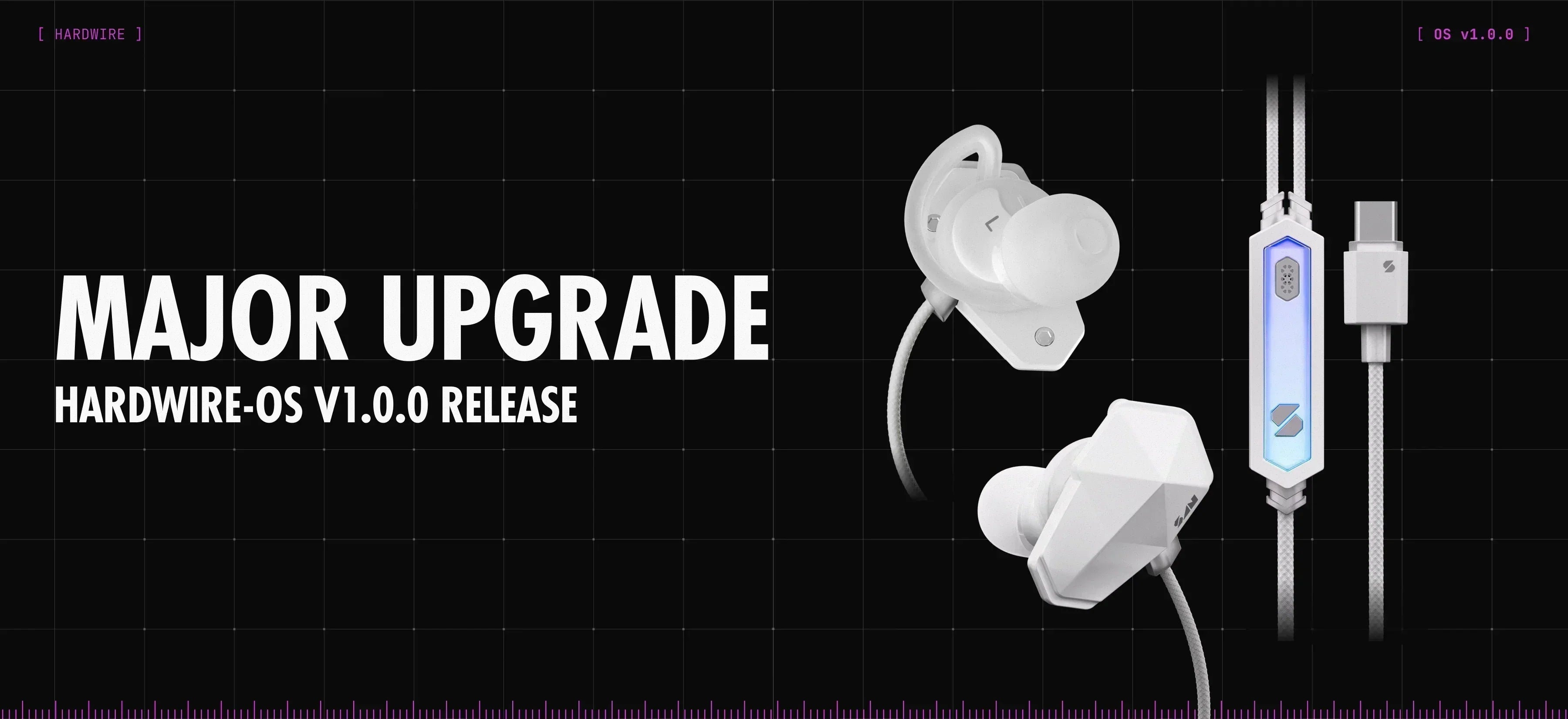
SYSTEM UPGRADE: HARDWIRE-OS v1.0.0 Release
Sound Profile Recalibration: After a new round of feedback, we have re-tuned our new Planar-Dynamic Driver across all three built-in sound modes (Default, Combat, and Open-World). These changes increasing clarity, add better spatial precision, and increase the overall soundstage detail and bass presence.
Audio Cortex Noise Floor & Android Fixes: We have resolved connection compatibility issues across various Android devices, and patched the Audio Cortex to reduce the baseline amplifier "hiss" (noise floor) in the Audio Cortex.
Added EMF Control via BLE Toggle: While Hardwire is fully-wired and only use low-powered Bluetooth (near-undetectable EMF levels) for communication with the Soundscape app, some users have expressed concerns for EMF radiation. We've introduced a feature that lets users completely turn off the low energy Bluetooth connection completely should they desire to.

The Bull and the Beast: MenaRD vs Daigo | Recap
Mena’s dominance has ushered in not only a Street Fighter renaissance in his home country, but a new era of Street Fighter as a whole.

Infinix | SAN Sound | IMCMPLX: The Endgame Mobile Gaming System
To mark the launch, we’re unlocking the full system. One winner will receive the complete GT50 Pro x HARDWIRE x IMCMPLX bundle: hardware, audio, and form, unified.
もっと読むInfinix | SAN Sound | IMCMPLX: The Endgame Mobile Gaming Systemについて

Audio Latency: Everything Breaks If Timing Does
The Price of Delays: In fast-paced competitive gaming, a typical Bluetooth delay of 100–200ms introduces a noticeable lag of roughly 12 frames in a 60 FPS title. With 1/5 of a second on the line, players are forced to contend with auditory cues that are already outdated.
Latency vs. Lag: Lag is a temporary network hiccup, whereas latency is constant hardware processing delay created and influenced by encoding protocols, wireless transmission, and decoding audio data.
Eliminating Bottlenecks Completely: While proprietary 2.4GHz connections are able to reduce wireless delay down significantly (SANWEAR's SANSYNC is able to bring it down to 20ms), direct USB-C digital wired connections remain the most reliable method to achieve absolute zero latency.


SANWEAR-HARDWIRE: v1.0 Release Notes
Community-Driven Improvements: Feedback from our initial "TEST TYPE-02" community prototype program directly shaped HARDWIRE as we know it now. Initial praise for its deeper sub-bass extension, studio-level clarity, and zero-latency plug-and-play design were all confirmed in the initial testing.
Acoustics Re-Tuned: Early reports of an overly "warm" sound signature that occasionally masked vocals and treble sparkle was addressed, along with other points for improvement in the launch release of Hardwire. The first version balances out the frequency spectrum by preserving the current strengths on the deep sub-bass, while opening up cleaner mids and crisper high-end detail.
Hardware and Cable Issues, Resolved: Physical changes include improvements in cable material that previously introduced microphonics (cable noise transferred through clothing). Other fixes include Android device detection protocols, and improvements in overall fit and finish of HARDWIRE.
Soundscape Ecosystem and Future Integrations: HARDWIRE launches with black/white colorways, full Soundscape app integration for EQ/RGB controls, and announced future plans for accessories such as extension cable solutions for desktop and console setups.
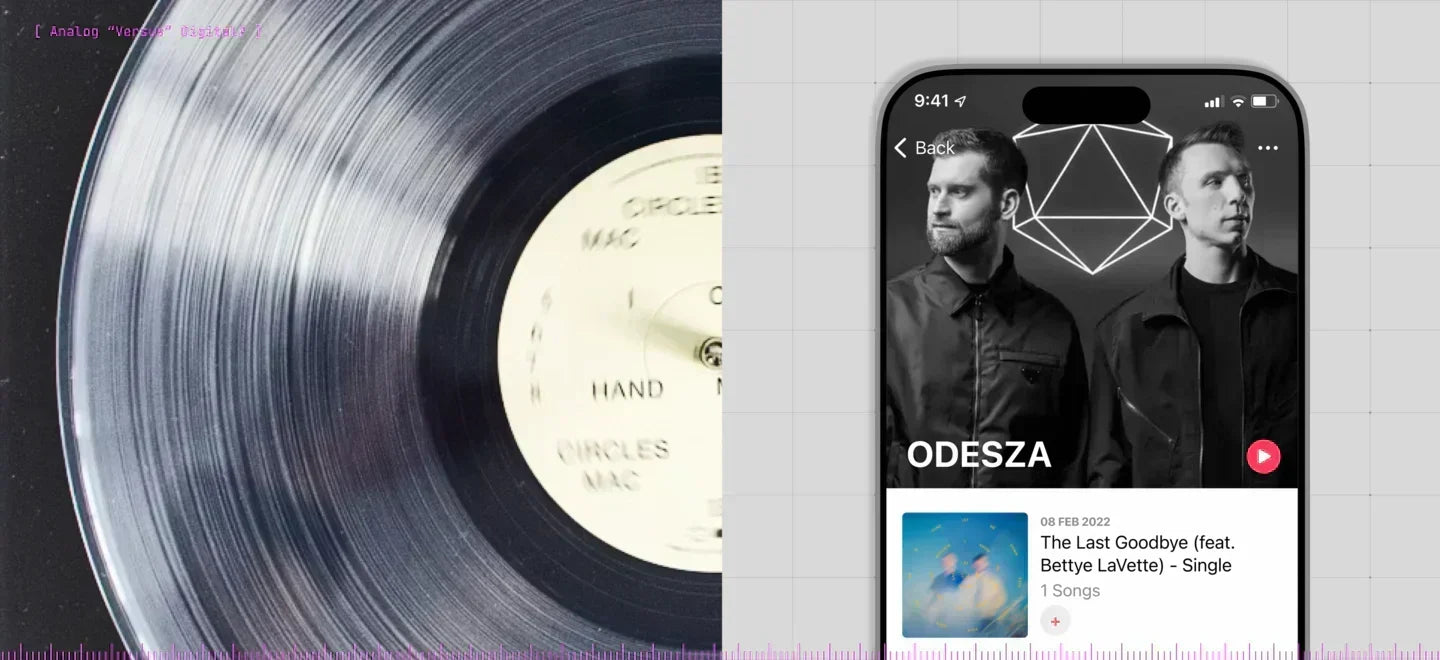
Analog “Versus” Digital?: All Audio Is Digital Until It Isn’t
The New Reality Of Modern Audio: Regardless of your stance in the debate on digital vs. analog, modern audio is fundamentally digital at its source. All media moves through data conversion layers before one final digital-to-analog step moves the physical driver.
Bottlenecks, Upstream and Down: Weak digital-to-analog conversion (DAC) or aggressive signal compression flattens any potential dynamic range that exists in the source, and degrades the fidelity of spatial audio. This dulls directional audio cues in competitive gaming, enhanced audio experiences watching movies and TV shows, and decreases the wideness of imaging in music.
Wired Advantages: While wireless protocols undeniably add convenience at the cost of extra conversion and encoding steps, a digital USB-C wired connection provides a leaner, direct path to source fidelity preservation as it moves down the sound processing chain.
Hardware-Level Spatial Purity: The integrated DAC inside the Audio Cortex manages signal conversion at the hardware level, maintaining precise 3D spatial audio without relying on artificial, sound-distorted audio through extra post-processing spatialization layers.
もっと読むAnalog “Versus” Digital?: All Audio Is Digital Until It Isn’tについて
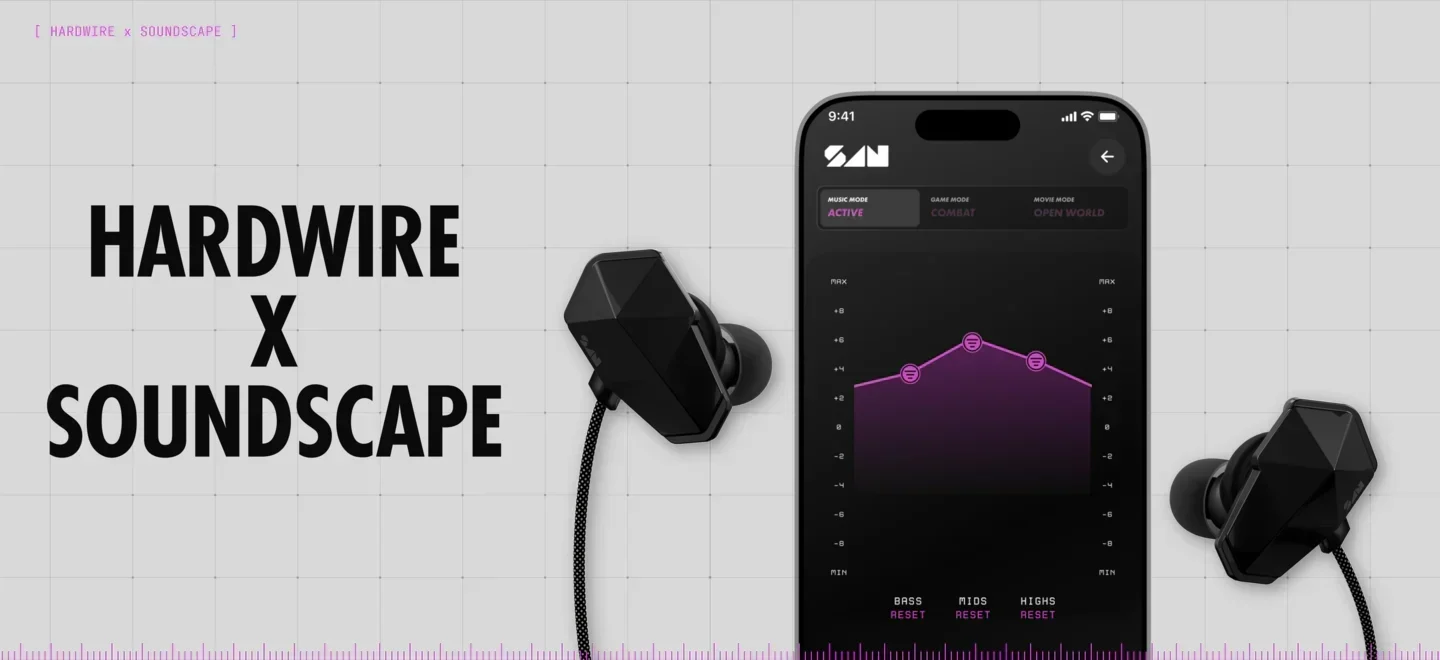
HARDWIRE x Soundscape: Audio That Evolves
Beyond Generic Companion Apps: Soundscape is more than your average EQ settings app. It is a continuous work-in-progress that evolves both software and hardware, through updates and optimizations; expanding HARDWIRE's, and future headphones', hardware capabilities over time.
In-line Onboard Processing: The integrated Audio Cortex houses a DAC, high-power amp, and DSP that locally stores all settings and configurations such as custom EQs, remapped button actions, and spatial profiles directly on the earbud; readily accessible across all platforms.
Level 11: To safely manage HARDWIRE's high-output amplifier, all settings default to safe volume limits. However, power users can sign an in-app waiver that lets Soundscape unlock the amp's full, unrestrained mode. Dial your HARDWIRE up to Level 11, if you dare!
Rejecting Planned Obsolescence: Designed with a performance headroom higher than we deem necessary now, our next-gen Planar-Dynamic driver and its upgradable architecture allows HARDWIRE to serve as a long-term audio platform. Through continuous firmware updates that enhance tuning, latency, and other optimizations, we help you keep your headphones alive rather than sell annually disposable incremental upgrades.
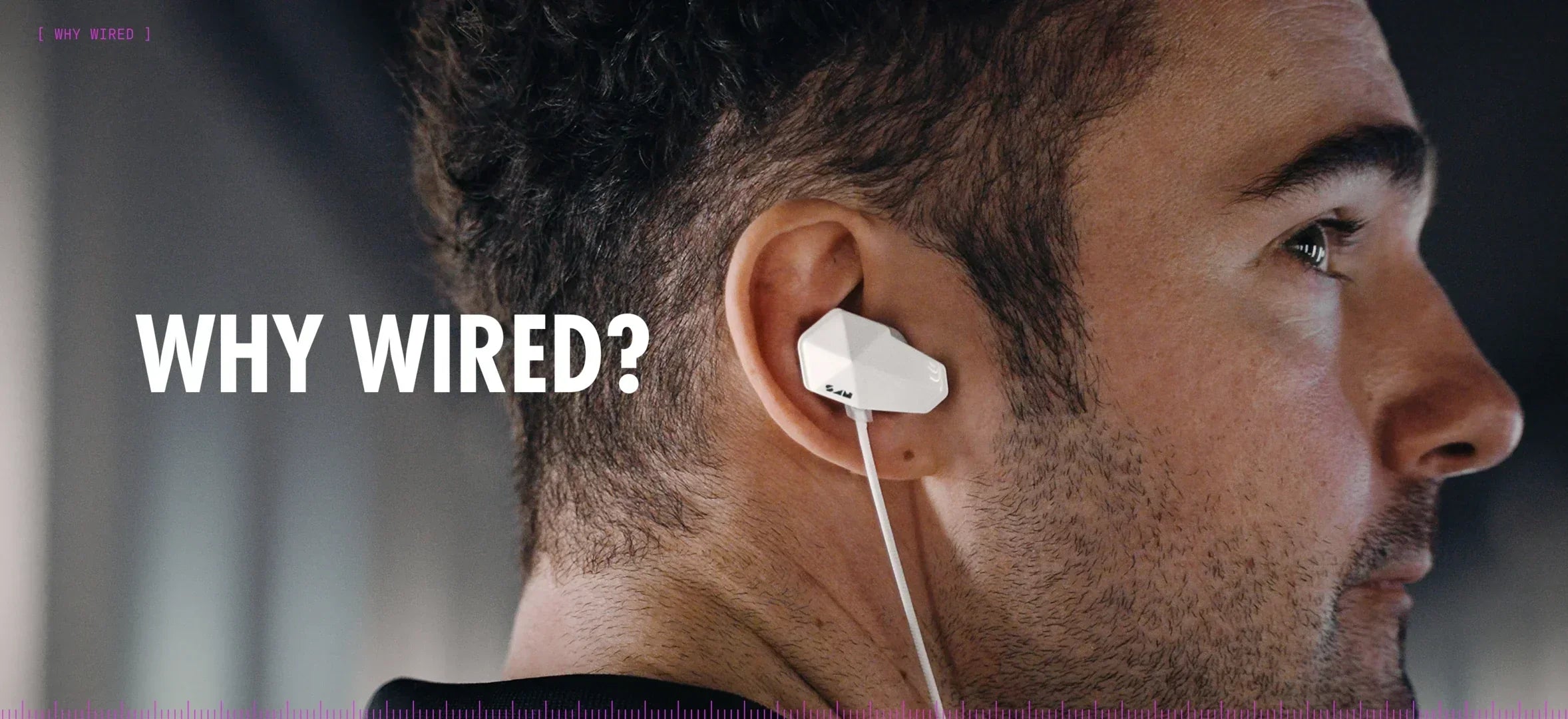
Wired Is BACK: Driven by convenience, simplicity, and the desire to unplug, wired earbuds are making a comeback, offering zero battery anxiety, no chance of lost buds, and a simpler, plug-and-play listening experience.
Latency Advantages: While ultra-low wireless protocols (like SANSYNC's own 20ms) are fast, no lag wired connections remain the non-negotiable gold standard for top-tier competitive esports.
Bridging Disposables With Complex IEMs: Budget wired earbuds sound tinny and break easily, while high-end audiophile in-ear monitors (IEMs) require expensive external DAC/AMP setups on top of hours of research, simply to get great sound quality. HARDWIRE bridges this gap as the premiere plug-and-play solution for high fidelity audio.
Wire For Music And Gaming: Audiophile IEMs are rarely able to balance music-centric and gaming-centric tunings in one device. HARDWIRE utilizes an integrated high-power amp and DSP inside the Audio Cortex to instantly toggle between different modes such as music, combat, and open-world spatial sound profiles.
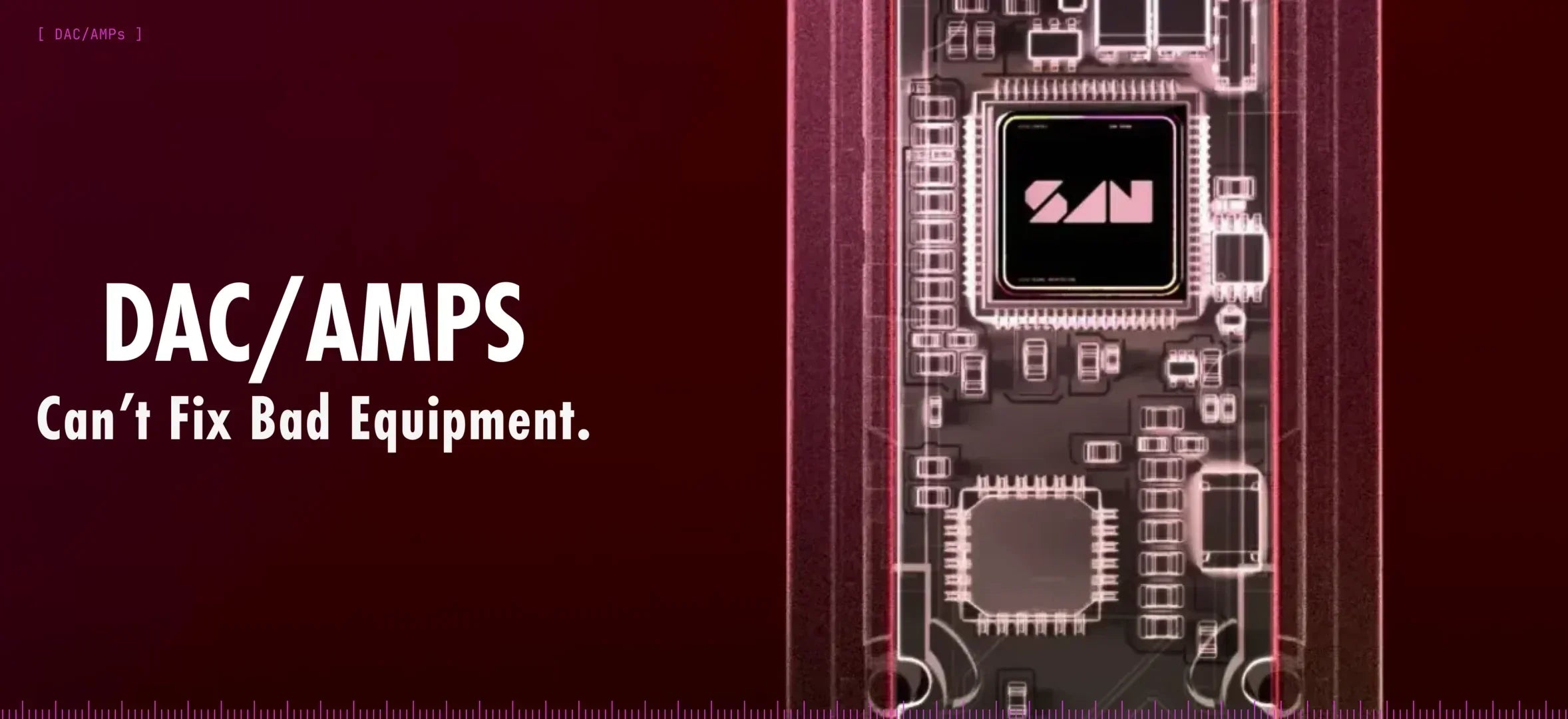
DAC/AMPs Can’t Fix Bad Equipment
DAC/AMPs Have Limits: An external DAC/AMP ensures a clean, isolated signal and proper power allocation for the driver. However, it cannot fix fundamentally weak drivers, poor tuning, or bad build quality.
When a DAC/AMP is Needed: Digital-to-Analog Converters (DAC) and Amplifiers (AMP) are essential when headphones sound thin due to underpowering, suffer from motherboard static/interference, or require finer volume granularity than the device's native digital volume steps allow.
Power Demands of Planar-Dynamic Drivers: Unlike standard power-efficient earbuds, HARDWIRE’s Planar-Dynamic architecture built for sound performance, requires a stable, high-current pwoer requirement, and precise signal paths that traditional 3.5mm audio jacks cannot supply.
Integrated Computational Processing: The Audio Cortex houses a dedicated DAC alongside an onboard DSP for local EQ storage, an adaptive learning ENC microphone processor, and customizable RGB lighting.
A Fully Self-Contained Solution: HARDWIRE integrates the DAC, AMP, and all computational processing directly into the headphone's wires, eliminating the use of any external dongles and sound quality bottlenecks, to deliver clean and uncompromising sound.
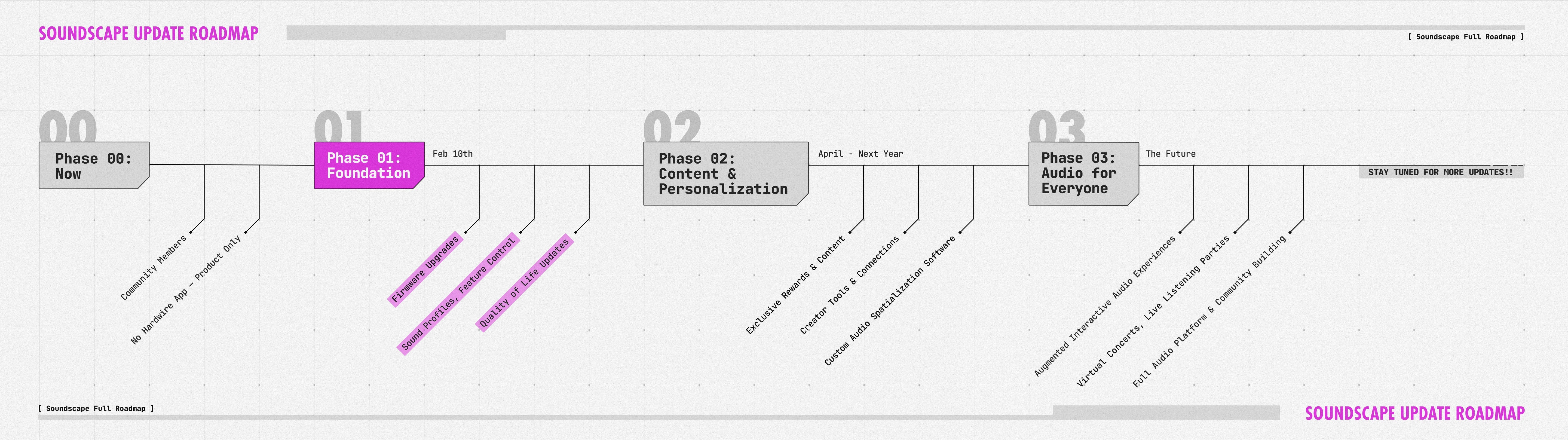
Breaking Conventions: Unlike analog headphones that never change after manufacture, SANWEAR functions as an evolving smart platform which continue to to receive updates and new features, powered by and in conjunction with the companion app, Soundscape.
Soundscape Now: Key features include customized sound profiles, sound driver tuning optimizations via firmware updates, RGB controls, exclusive content, amplifier controls for HARDWIRE's Audio Cortex, and more
Soundscape In The Future: Going beyond an EQ controller, our mission with Soundscape is to transform it into your premiere spatial audio hub. We aim to introduce Dolby Atmos collaborations, spatial mixing utilities, artist-monetization tools, and user rewards like artist-tuned EQs and avatar accessories.
The Soundscape Ecosystem: Our long-term goal is to provide users with synchronized auditory social experiences that include virtual concerts with spatial audio features and enhancements, ultra-low latency multi-earbud listening parties, and community-driven music discovery. Earbuds have long isolated us, it's time to bring everyone back.
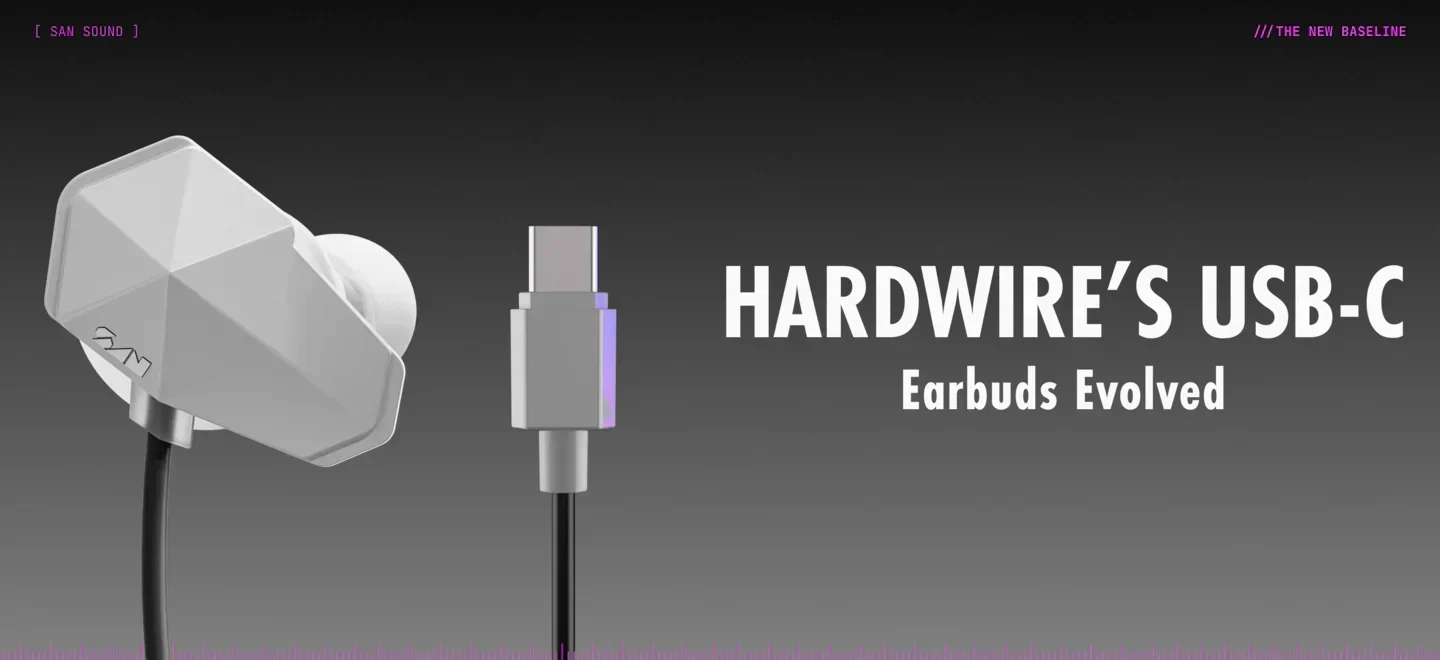
SANWEAR-HARDWIRE's USB-C: Earbuds Evolved
A New Paradigm Shift: When Apple first removed the 3.5mm headphone jack, it forced the whole industry to shift towards USB-C. While initially an inconvenience to both consumers and manufacturers alike, in time both saw the benefits that wired USB-C earbuds brought that improved sound quality. As well as opening the doors to better integrated sound processing hardware such as Digital-Analog-Converters (DAC).
Bypassing Outdated Terminals: USB-C transfer raw digital audio signals directly to HARDWIRE’s onboard DAC/AMP, eliminating additional layers of interference and distortion, as a result of relying on cheaper and unshielded phone or PC audio hardware.
Better Power Management: Connecting through USB-C offers significantly more power output compared to 3.5mm headphone jack, which maxes out at 0.5W. This additional power is needed by the Audio Cortex to deliver the consistent amount of power needed by our next-gen Planar-Dynamic drivers, ensuring the same high quality holographic audio whether you're plugged into a $50 MP3 player or a $2,000 PC.
Two-Way Data Transfer: Unlike 3.5mm cables, USB-C includes a dedicated data transfer channel allows additional features such as EQ and sound profile storage on the earbud itself, profile customization, and firmware updates via the Soundscape app; all without any interference or degradation on the sound quality.
Sound Quality Consistency: Digital processing overcomes natural manufacturing variances more present in analog components, such as the 3.5mm audio jack, guaranteeing the user a consistent, and uncompromised level of sound quality across all devices.
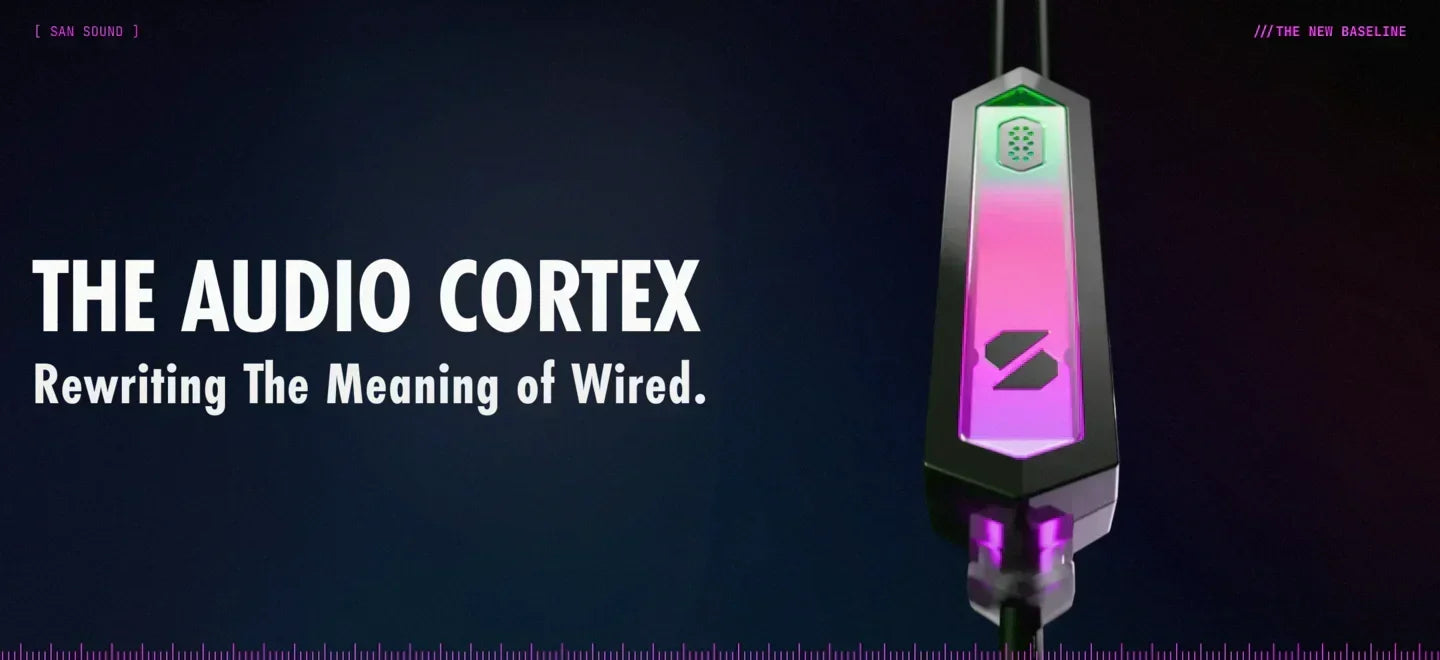
The Audio Cortex: Rewriting the Meaning of Wired
Integrated Sound Processing: The Audio Cortex consolidates and integrates power delivery, digital-to-analog conversion (DAC), signal processing (DSP), amplification, mic processing, hardware controls, and more directly into the wire.
Eliminating The Analog Bottleneck: Traditional wired earbuds rely on the variable output quality and potentially weak internal DACs of devices such as phones, laptops, consoles, and PCs. The Audio Cortex takes over the entire signal chain to ensure zero-latency, highest-fidelity sound regardless of what device it's plugged into.
Platform-Agnostic Memory Storage: Custom EQ profiles, firmware updates, and tuning data are all stored locally inside the headphones. Once settings, sound profiles, and remapped actions button configurations are configured via the Soundscape app, your audio remains the same whether on PC, console, mobile, or handheld devices.
Redefining Wired: The Audio Cortex transforms wired earbuds from a bare copper cable into a self-contained, digital-first system that's engineered for the modern lifestyle. Enjoy spatial audio the best way possible whether it's your favorite albums, TV shows, movies, games, or other media.
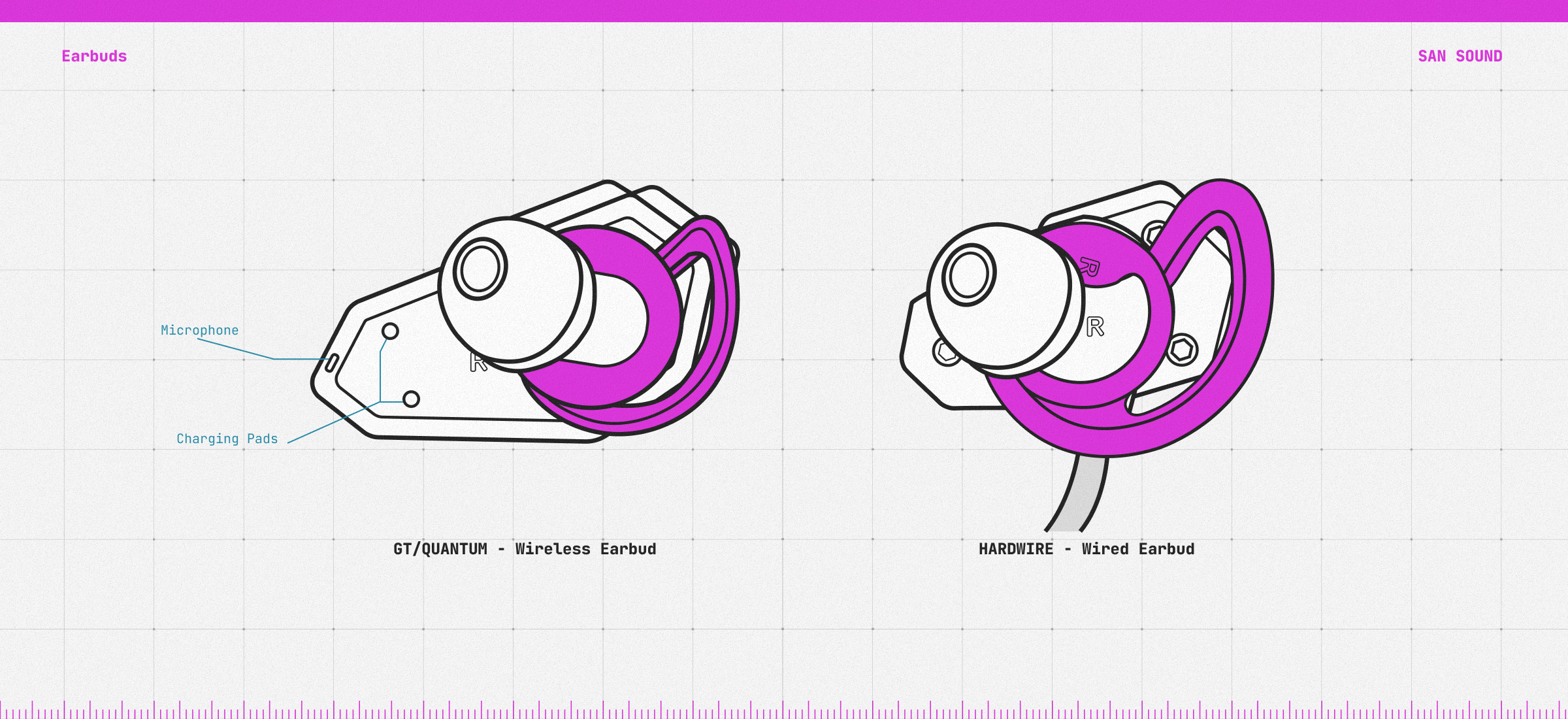
Beyond Comfort: Merging Ergonomics With Sound Fidelity
Your Average In-Ear Headphones Have a Problem: They function like earplugs, placing a friction-based load-bearing weight directly inside your ear canal. Because the inner ear is very sensitive, with a high concentration of nerve endings, this pressure inevitably causes severe discomfort over long listening sessions.
Re-Engineering Weight Distribution: SANWEAR utilizes internal sport hooks that anchor the earbud's weight into the outer ear, a more naturally rigid and less sensitive part of the ear. This completely removes any physical strain from the more sensitive inner-ear.
Aligned For Quality : A specially angled nozzle keeps the device centered over the ear canal opening without touching its walls. In combination with the sport hooks, the silicone eartip's sole responsibility is to only secure the physical seal and nothing more. Conventioneal earbuds need to both maintain the seal and secure the buds in place.
Better Noise Isolation Benefits: By keeping the ear tip purely focused on sealing rather than load-bearing, SANWEAR achieves maximum passive noise isolation and the fullest sound quality, without needing Active Noise Cancellation (ANC) and the additional latency and battery drain with it.
もっと読むBeyond Comfort: Merging Ergonomics With Sound Fidelityについて
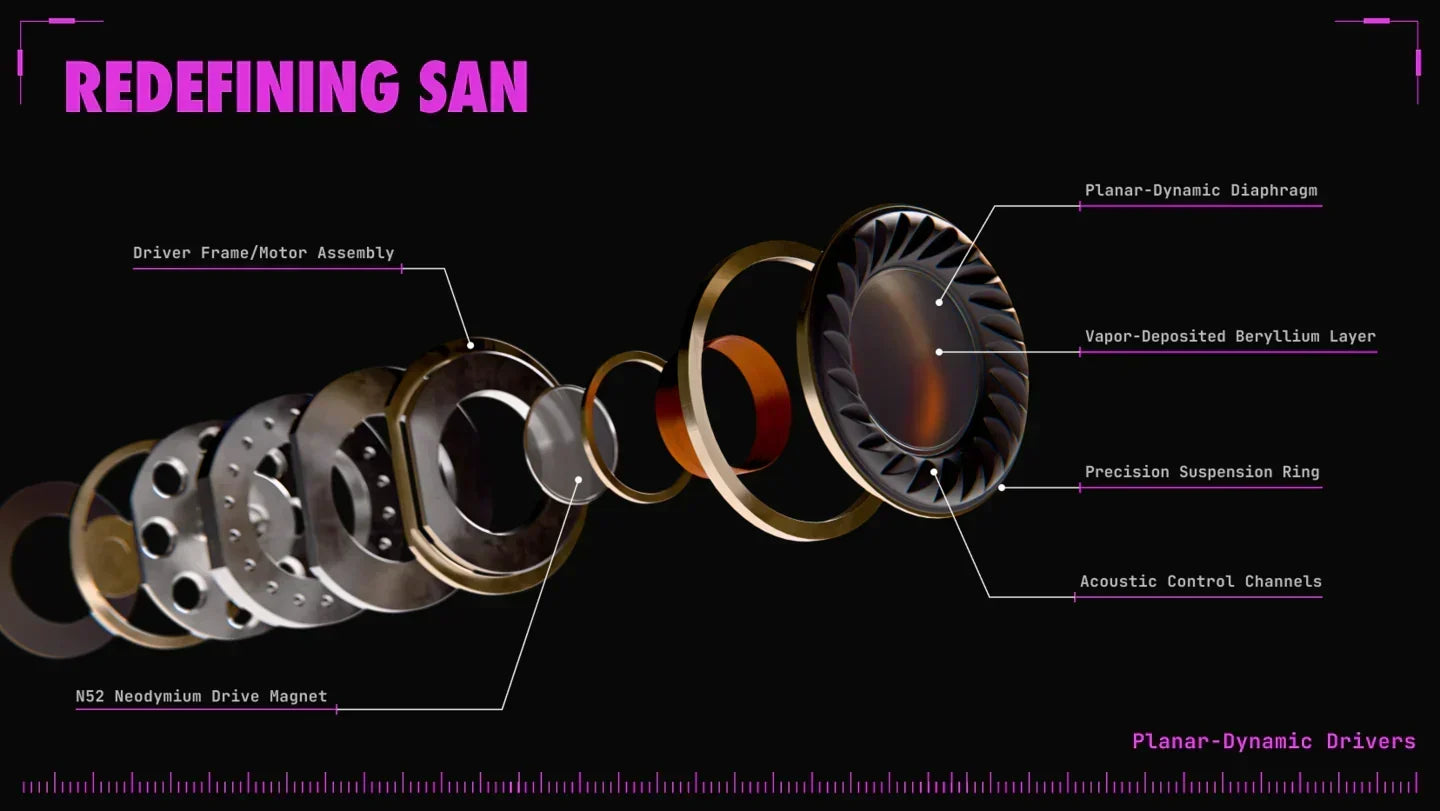
The Dynamic Driver: These drivers excel at producing impactful bass and weighted, textured mid-frequencies. However, the stretching and flexing of the outer diaphragm still causes distortions inherent to this driver type design.
The Planar-Magnetic Driver: Planar drivers utilize a flat diaphragm suspended between magnets that move air linearly, and uniformly. This drastically reduces distortion and sharpens spatial cues. However the resulting sound often lacks physical bass punch, requires more power, and can sound clinically sanitized.
SAN's New Planar-Dynamic Driver: We at SAN Sound engineered our new custom Planar-Dynamic driver that has the best of both worlds. This new design delivers deeply extended, disciplined bass and natural mid-tones without treble harshness. The uniform surface reduces sound irregularities, creating clear positional cues and a stable, holographic soundstage for gaming.
The New Baseline: The Planar-Dynamic system merges technical speed with emotional realism, establishing the foundation for SAN's next generation of performance earbuds.

Do Earbuds Really Sound as Good as Headsets?
Bigger Does Not Always Mean Better: The assumption that 50mm headset drivers inherently outperform 8mm earbud drivers is outdated. Good sound quality is dictated more by engineering, material composition, and chamber design rather than sheer size.
Premium Materials at The Right Scale: Because earbud drivers require significantly less material mass, engineers can cost-effectively utilize more exotic, high-performance materials such as SANWEAR’s beryllium-graphene composite diaphragms and N52 neodymium magnets, that would be financially or physically impractical at headset level.
Proximity and Spatial Precision: Competitve spatial audio relies on clean, low-distortion delivery over pure volume. Earbuds sit directly outside the ear canal, minimizing air gaps and earcup reflections that are able to provide sharper positional cues and better directional accuracy than headsets.
No Need For ANC: Active Noise Cancellation degrades audio quality and accelerates battery drain. Earbuds use silicone ear tips as Passive Noise Cancellation (PNC) that create a physical barrier between your audio and the outside world. In addition, the lack additional sound processing by well-fitting eartips minimizes battery drain. Better sound quality + better noise isolation for longer.
A New Eara in Audio: The time of earbuds being the backup option ended when professional-grade in-ear monitor (IEM) technology entered the mainstream. This drove the demand for better, higher-quality earbuds that match or exceed headset performance.
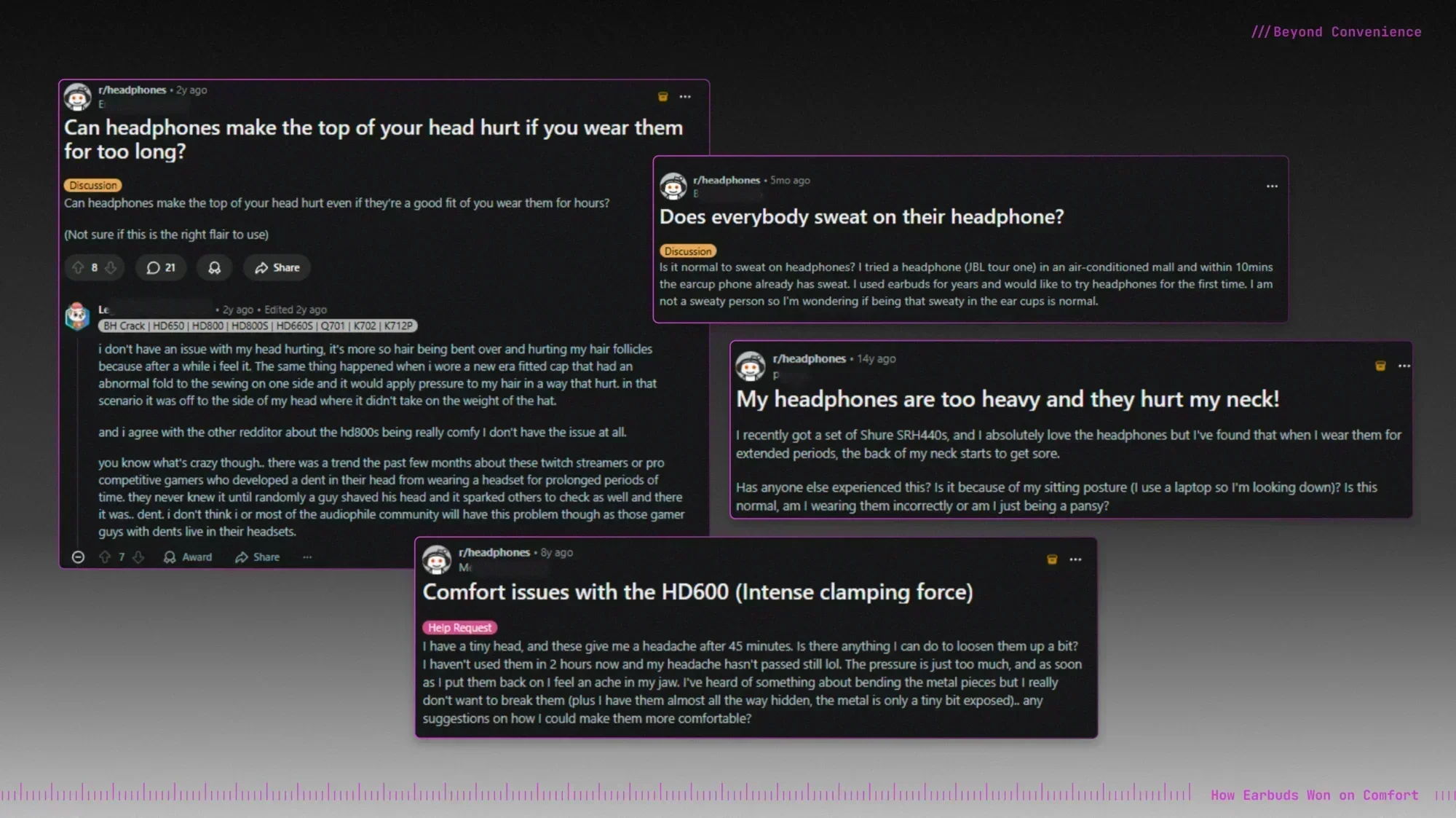
Beyond Convenience: How Earbuds Won on Comfort
Obligatory "Headset Fatigue": Conventional beliefs have long treated clamping pressure, trapped ear cup heat, and neck strain as the price to pay for high-quality audio.
Old Designs For Old Tech: Traditional headset architecture relies on a one-size-fits-most, spring-tensioned headband design originally engineered for use in the military. Not for prolonged personal use, designed to be a comfortable experience.
The Earbud's Ergonomic Advantage: By resting directly inside the ear canal, earbuds eliminate clamping forces entirely. This removes extra weight imposed on the neck, prevents heat and moisture buildup through open ventilation, and allows glasses frames and other accesories to be worn unrestricted.
Better Seal, Better Performance: Early earbud designs suffered from poor fit because they were treated as backup devices. High-fidelity earbuds require a precision fit since a proper seal creates an isolated acoustic chamber necessary for accurate imaging in both deep bass and spatial audio.
Comfort is a Competitive Advantage: Physical discomfort siphons mental bandwidth away from gameplay, slowing reaction times and reducing endurance. True comfort makes the audio equipment invisible from one's cognitive load, freeing up to 100% of focus for matches.

持ち運びやすさのパワー:Elite Audioはポケットに収まる(そして収まるべきだ)
モバイルゲームと従来のゲームの境界線は曖昧になり、ゲームルームの枠を越えたにもかかわらず、根本的な摩擦は依然として残っています。それは、オーディオはどうなるのか、ということです。