


If you’ve been paying any attention, you’ll have seen many major tech companies pushing something new: Spatial Audio. Even though it may feel like new technology, spatial audio already exists in a lot more media than most people realize.
Every game has it. Blockbusters are using it. Apple Music has a dedicated category for it. But not all hardware is able to recreate the spatiality of that sound faithfully.
But before we go any further, what is spatial audio?

At its core, spatial audio is the natural evolution of surround sound. Surround sound simulates a space through a fixed set of outputs (speakers), while spatial audio takes it further by placing real ‘audio objects’ in a simulated 3-dimensional space, giving a much more realistic picture of where sound is coming from. Formats like Dolby Atmos place sounds within a three-dimensional environment through recording techniques and mastering in specialized software.
While a proper Dolby Atmos setup requires upwards of 12 speakers positioned all around the room, most of us only have access to 2: left and right. This has been ‘solved’ using algorithms that give the illusion of 3D sound. The challenge is, as always, reproducing sound accurately through the hardware.
With all that said, what is it that separates good spatial audio from bad?
We’ve identified three markers.

Spatial Audio Reproduction Needs These Three Things
1. Direction
Direction is arguably the easiest spatial cue to reproduce.
Even basic stereo headphones can tell you whether a sound is coming from the left or right. However, accurately placing sounds throughout a full 360-degree environment is much harder. There are usually hardware limitations that result in auditory blind spots or dead zones, which makes simulating sounds coming from the front or back very difficult.
2. Distance
Distance is where headphones start having difficulty reproducing spatial audio accurately.
In the real world, our brains constantly judge how far away sounds are based on volume. However these are also affected by the reflections of sound across surfaces, environmental acoustics, and subtle frequency changes from irregularities in the area like leaves, clutter, and debris. Less-capable headphones are unable to reproduce that sound accurately and your sense of distance just won’t be there.
But there’s something even more difficult to reproduce than distance.
3. Elevation
Elevation is perhaps the most difficult spatial cue for headphones to reproduce accurately. This is largely because we humans are naturally good at detecting sounds around us on a horizontal plane.
Determining whether something is above or below, requires far more subtle information. This is why many headphones struggle to convincingly place sounds vertically. What feels like an aircraft flying over you is often actually just sound travelling from sideways aided by visuals.
Modern media already contains all the spatial data and information needed for these three markers. The goal now is to reproduce them accurately.

The SANWEAR Difference
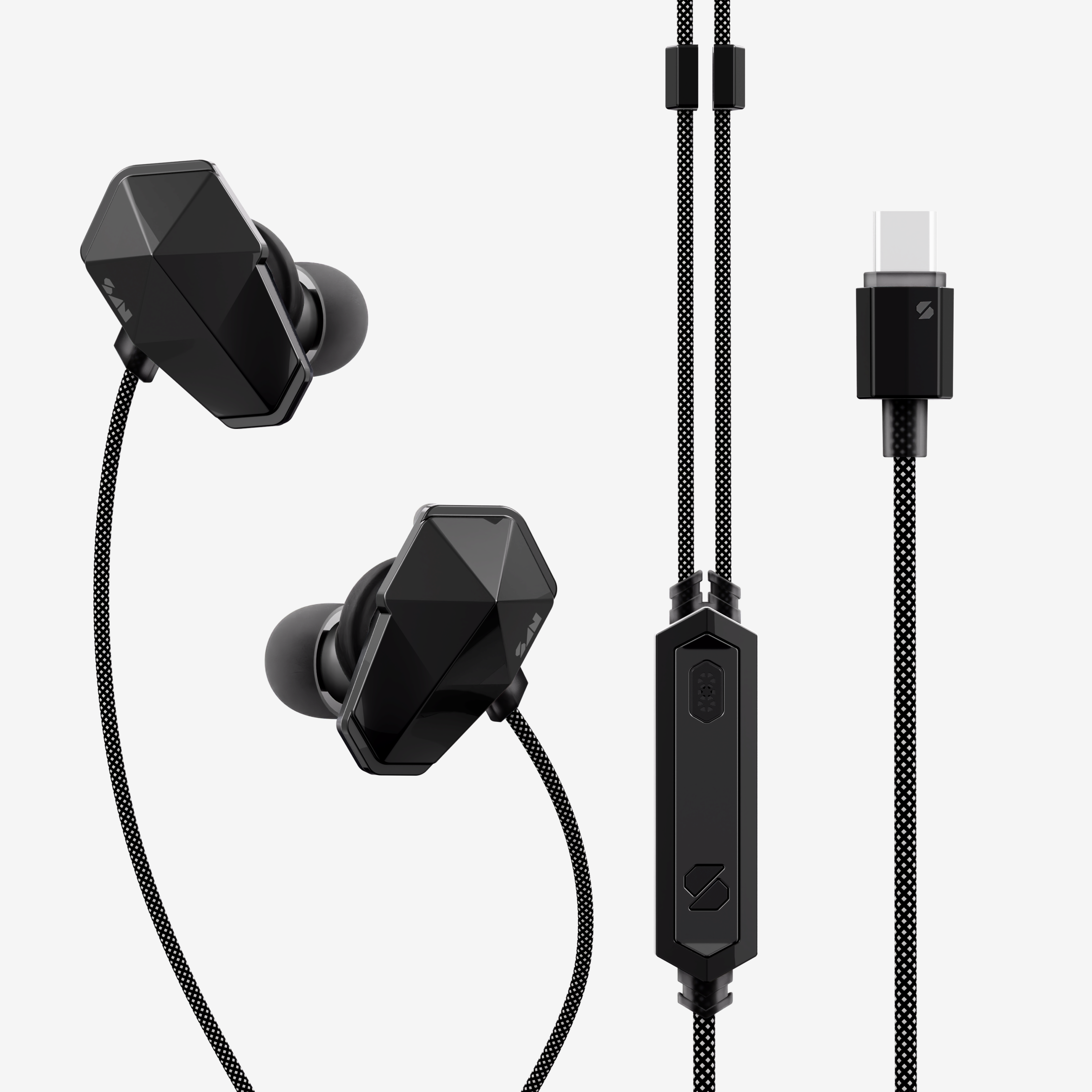
Great spatial audio experiences lie beyond the frequency graph measurements and EQ profiles. While other earbuds focus on delivering the most widely-appealing, neutral, music-focused sound, our approach to SANWEAR is geared solely toward unmatched spatial fidelity. From the tuning to the architecture of the driver itself, to the processing and tuning in the Audio Cortex, SANWEAR is built for spatial.
Sub-Bass Imaging
SANWEAR maintains directional accuracy at under 80Hz, where most other systems collapse. Our imaging preserves realistic volume replication in the sub-bass range, delivering incredible directional accuracy and extra texture in the bass that our brains use to determine distance.
Single Driver Excellence & Consistency
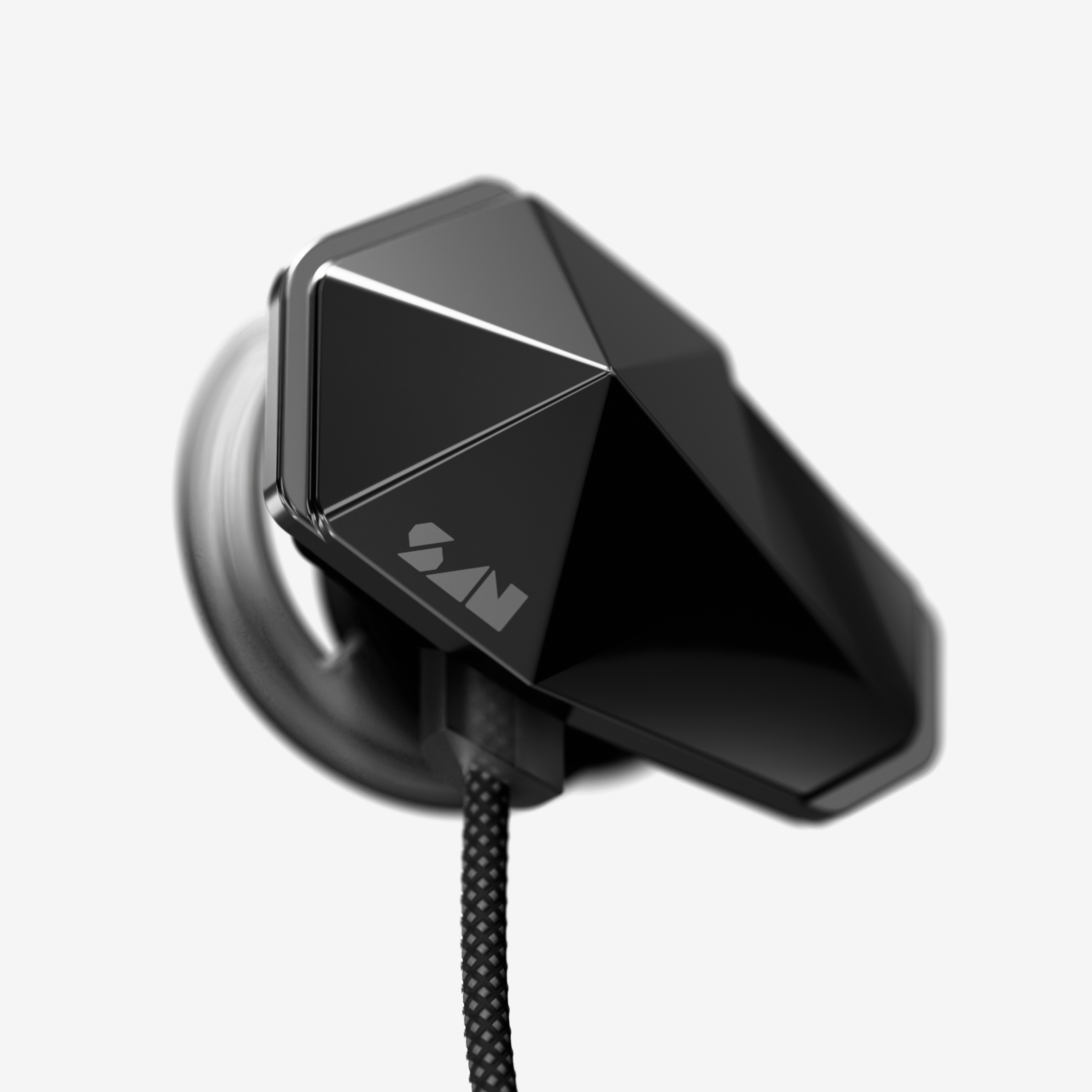
Spatial audio requires perfect timing. Multi-driver systems split frequencies across separate components, introducing phase distortion and timing errors at the crossover points. We use a single, specially designed dynamic driver to maintain full-spectrum coherency and deliver a precise spatial soundstage. Ensuring consistency in every unit, our production process uses meticulous driver matching protocols and quality control systems that make sure every driver performs consistently with its partner.
Hyper Range Extension
One common cause of unrealistic or small sound is that drivers are not capable of pushing air rapidly or precisely enough to replicate a realistic sound stage, especially when replicating distance and in the sub-bass range, where this matters most.
Our driver’s architecture and material use allow greater travel and air displacement, reaching deeper lows and cleaner highs without distortion. That range unlocks full-spectrum spatial cues, retrieving the extremely subtle micro-details that contribute to the ever elusive feeling of elevation.

When Spatial Evolves To Holographic
After years of development, we believe that with SANWEAR, spatial audio pushes beyond a simple auditory tech demo into a complete sensory experience.
Our drivers and Audio Cortex technology reproduce as much of the spatial information from the source as possible, allowing us to place objects precisely in 3D space with unmatched precision and presence. The result is holographic audio.
In games, sound becomes a true extension of your capability to perceive the virtual world around you, like a radar in your ears.
For movies and shows, you’re in the car for the chase, the building is falling on top of you, you’re hiding from the helicopters. Monsters feel big, and the kaijus feel bigger. The quiet moments feel closer, more intimate.
In music, songs open up so that instruments can genuinely surround you. You’re listening to the same song in the studio, or from the front row of the concert, or in the best seat at the opera house. Each of these experiences distinct and special.
Right now, it’s up to the artist’s vision and will to create. At SAN, it’s our job to dissolve the barriers that separate you from their work.
We built SANWEAR to give you sound that places you directly in a time and space. Give you sound you can almost see.
Sound that’s holographic.
Learn how over two decades of audio engineering shaped SANWEAR’s philosophy to sound.
Get Addicted To Sound | Explore SANWEAR
//END TRANSMISSION//





分享:
UPDATE: HARDWIRE FOR EVERYONE | Open Availability Starts June 17
The In-Ear Advantage: What In-Ear Headphones Do That Over-Ear Doesn’t